1. The Wrong Starting Question
Enterprise technology leaders increasingly enter strategy meetings asking: “How can we add AI to our business software?”
That is almost always the wrong starting question.
Adding artificial intelligence simply because the interface needs an “AI button” or because industry buzzwords demand it produces costly gimmicks that employees quickly abandon. The decisive architectural question serious software engineers must ask is:
The Foundational Question
"Which specific steps in this workflow benefit from probabilistic intelligence — and which steps must strictly remain deterministic business software?"
Traditional Software excels at rules, ACID transactions, permissions, and mathematical calculations. It is deterministic: 2 + 2 always equals 4, and an unauthorized employee can never view the payroll table.
Artificial Intelligence excels at unstructured understanding, classification, synthesis, and pattern matching. It is probabilistic: it predicts the most likely interpretation or next step.
Great software architecture does not replace traditional software with AI. AI should augment reliable business software, operating as an intelligent acceleration layer above a rock-solid deterministic foundation.
2. Six Places AI Creates Real Business Value
In production enterprise software, AI delivers tangible ROI across six distinct operational capabilities:
-
Understand (Document & Natural-Language Intelligence):
Reading complex PDF vendor invoices, extracting unstructured email requests, parsing physical shipping bills of lading, and converting messy text into structured database records.
-
Classify (Categorization & Routing):
Analyzing inbound customer support tickets, categorizing expense claims, identifying document types, and routing tasks to the appropriate department queue automatically.
-
Generate (First-Draft Synthesis):
Drafting customer quote summaries, summarizing lengthy legal agreements, generating personalized email follow-ups, and compiling first-draft meeting minutes for human review.
-
Recommend (Contextual Decision Support):
Suggesting the optimal restocking quantity based on seasonal patterns, recommending cross-sell components during quote creation, or proposing next best actions for customer success reps.
-
Predict (Operational Anomaly Detection):
Identifying equipment telemetry drift before a factory breakdown occurs, flagging unusual payment transaction spikes, or forecasting delivery delay probabilities.
-
Automate (Guarded Workflow Execution):
Executing routine data reconciliation tasks when confidence thresholds are high, reserving human intervention strictly for edge cases and exceptions.
3. Where AI Should NOT Replace Traditional Software
Understanding where AI must never be used is as vital as knowing where to apply it. AI models are probabilistic engines—they are prone to hallucinations, variance, and non-deterministic behavior.
The following capabilities must always remain strictly in traditional deterministic code:
- Financial & Tax Calculations: Invoice totals, GST/VAT computations, discounts, and currency conversions must run in audited business code. Never use an LLM to calculate a financial total.
- Authoritative Accounting Ledgers: Double-entry bookkeeping must obey rigid relational database constraints and immutable transaction logs.
- Permissions & Access Control (RBAC): Determining whether a user has permission to delete a record or view confidential employee salaries must be enforced by deterministic authorization middleware.
- Inventory Deductions & Reservations: Authoritative warehouse stock counts must be locked and updated via ACID database transactions.
- Irreversible Compliance & Legal Actions: Terminating accounts, executing large wire transfers, or filing regulatory forms should always require explicit deterministic rules and human authorization.
4. The AI Confidence & Governance Model
To deploy AI safely into enterprise workflows, architects implement a tiered Confidence Routing Model:
Assist & Automate
Standard documents or routine classifications with high model certainty execute automatically, with an audit log for review.
Human-in-the-Loop Review
The AI prepares a pre-filled recommendation or draft. A human staff member reviews, verifies, and approves with one click.
Manual Routing & Inspection
Novel edge cases, ambiguous documents, or conflicting data are flagged immediately for standard manual handling.
This model protects business accuracy while eliminating 70% to 80% of routine clerical drudgery for your workforce.
5. The Enterprise AI Architecture Stack
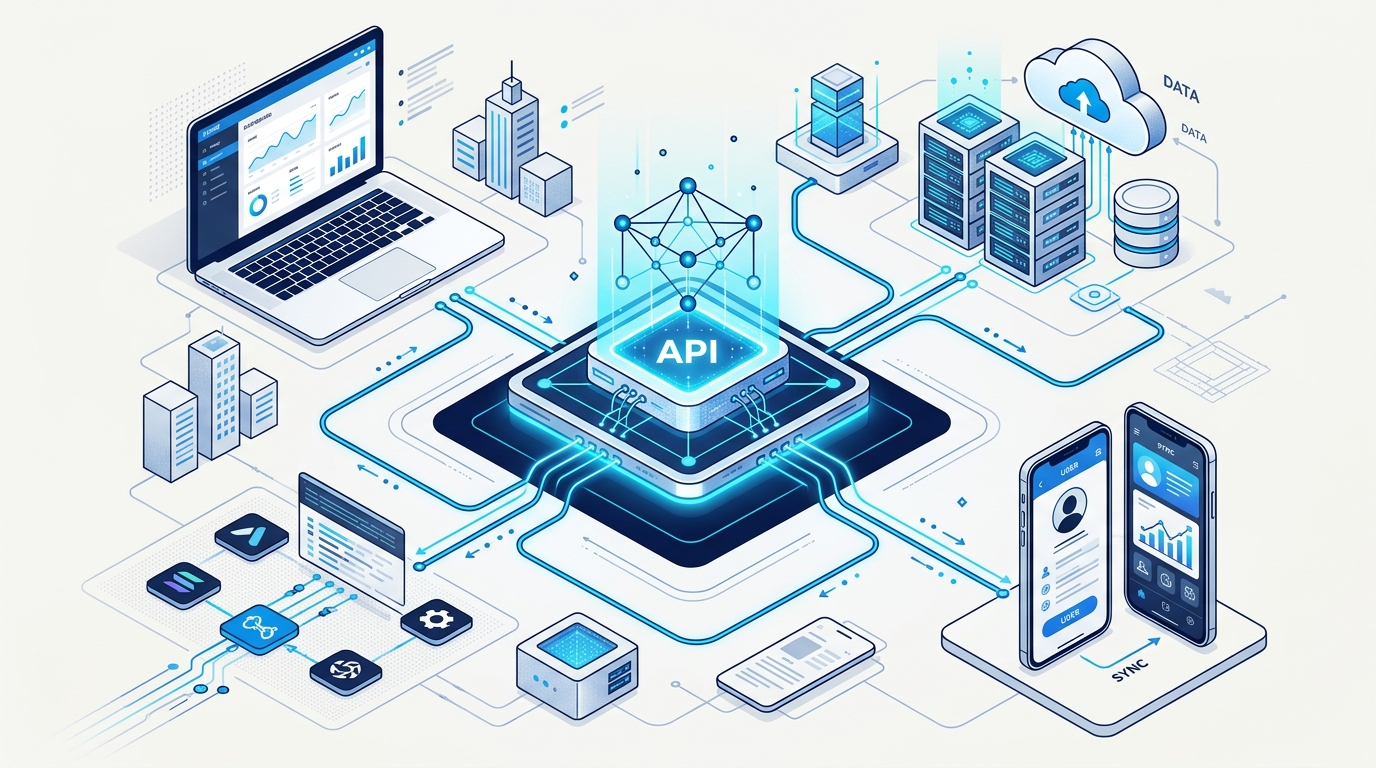
A production-ready business AI architecture is not a direct API call from a webpage to OpenAI or Anthropic. It requires a layered architectural stack:
AI + Business Data: Retrieval & Permissions
Giving an AI model access to your internal business data (via Retrieval-Augmented Generation or RAG) requires strict enterprise boundaries. If an employee queries an internal knowledge assistant, the AI orchestration layer must only retrieve document chunks that the specific employee’s credentials authorize them to see. Business security and data isolation must precede AI implementation.
Add AI when it measurably improves speed, accuracy, decision support, and operational margins.