1. The Software Dilemma: Build, Buy, or Both?
Every growing business eventually arrives at a decisive technology crossroads. Operations expand, spreadsheets begin breaking under transaction volume, customer expectations rise, and existing systems can no longer keep pace.
Your business needs modern software. It might be:
- An enterprise resource planning (ERP) system or custom CRM
- A multi-location inventory and supply chain engine
- A customer-facing self-service booking portal
- A vendor or dealer management platform
- An automated quotation, pricing, and order approval system
- A proprietary mobile field application for technicians or inspectors
- A centralized operational intelligence and executive reporting dashboard
When leadership gathers to discuss the initiative, the debate usually polarizes into two immediate camps:
“Let’s build our own system so it does exactly what we want without monthly per-user fees.”
Or:
“Let’s just buy an off-the-shelf SaaS product so we can turn it on next Monday.”
In practice, neither instinct is automatically correct.
Buying software without evaluating your unique operational edge often forces your company into generic industry molds, eroding your competitive advantage. Conversely, building software from scratch for standard commodity functions burns hundreds of thousands of dollars reinventing commodity wheels that specialized vendors already perfected.
The decisive strategic question executive leaders must ask is:
The Strategic Question
"Which of our business capabilities are standard commodities — and which capabilities genuinely differentiate our business in the eyes of customers and bottom-line margins?"
2. The Core Principle: Buy Commodity, Build Differentiation
Modern software strategy rests on an unambiguous economic law:
Build differentiated capabilities.
While this principle sounds simple, real-world business architecture is rarely binary. Most enterprise applications encompass a spectrum of capabilities ranging from universal back-office utilities to proprietary business logic:
- Financial Accounting vs. Custom Quotation: General ledger, chart of accounts, tax reporting, and balance sheets are strictly governed by statutory regulations. Buying standard accounting software (Tally, QuickBooks, NetSuite) makes overwhelming sense. But if your business wins contracts because of a proprietary 12-factor engineering estimation algorithm, embedding that logic into a custom quotation engine creates immediate competitive advantage.
- Email Infrastructure vs. Customer Workflow: No enterprise should build an email delivery server or video conferencing tool. But building a bespoke customer portal that guides clients through an interactive order configuration workflow can double conversion rates and streamline fulfillment.
- Payment Gateways vs. Order Orchestration: Processing credit cards and bank transfers should leverage proven gateway APIs (Stripe, Razorpay) for PCI-DSS compliance. However, coordinating multi-vendor split settlements, escrow approvals, and localized delivery dispatch requires custom business software.
Recognizing this distinction transforms technology from a painful operational expense into a deliberate strategic asset.
3. What Does "Buy" Actually Mean?
When an organization decides to "buy" software, it acquires the right to use an existing commercial product created, hosted, and maintained by a third-party technology vendor.
In modern enterprise environments, buying encompasses several delivery models:
- Software-as-a-Service (SaaS): Multi-tenant, cloud-hosted platforms accessed via web browsers and mobile apps on recurring monthly or annual subscriptions.
- Commercial Off-The-Shelf (COTS): Packaged enterprise software licenses deployed either on vendor cloud infrastructure or private cloud environments.
- Configurable Vertical Platforms: Industry-specific packages designed for particular verticals (e.g. specialized medical practice management, automotive dealership management, or standard retail POS).
Commonly Standardized Requirements
Across industries, certain back-office and communication requirements are overwhelmingly standardized:
- Corporate email and calendar suites
- Statutory accounting, tax compliance, and payroll processing
- Secure file storage and digital asset management
- Video conferencing, team messaging, and chat
- Standard pipeline CRM for routine lead tracking
- Basic project management and internal task ticketing
Unless your company's core business model is competing directly in one of these categories, building custom software for these functions is an irresponsible allocation of capital.
4. The Strategic Advantages of Buying
When applied to suitable commodity requirements, commercial software offers undeniable business advantages:
-
Rapid Time-to-Market:
Because the software already exists, your organization can sign a contract, configure user permissions, and begin operating within days or weeks rather than waiting months for development.
-
Lower Initial Capital Outlay:
Rather than committing substantial upfront capital to software architecture, design, and engineering, you pay an initial setup fee and manageable monthly subscription.
-
Proven Workflows & Best Practices:
Established commercial platforms have been refined across thousands of customer organizations. Their workflows have already solved common edge cases, reporting conventions, and operational workflows.
-
Vendor-Managed Infrastructure & Security:
The software vendor shoulders responsibility for server uptime, data center redundancy, DDoS protection, database backups, operating system patches, and compliance certifications (SOC 2, ISO 27001).
-
Ecosystem & Third-Party Integrations:
Major commercial platforms boast mature marketplaces with pre-built connectors to popular tools (Zapier, Slack, Google Workspace), comprehensive user documentation, and certified implementation partners.
5. The Hidden Limitations of Buying
Despite its appeal, off-the-shelf software introduces distinct operational compromises that become acute as a business expands:
-
Compounding Per-User Subscription Costs:
A SaaS tool charging $50 per user per month seems economical for 10 users ($6,000/year). When your workforce grows to 150 employees, that single subscription escalates to $90,000 annually—and SaaS portfolios frequently include 8 to 15 separate subscriptions per business.
-
The "Lowest Common Denominator" Problem:
Commercial software is engineered to satisfy the median requirements of thousands of businesses. It is not designed to accommodate your specific operational nuances. When your workflow deviates from the vendor’s rigid workflow, your team is forced into cumbersome manual workarounds or external spreadsheets.
-
Vendor Lock-in & Data Portability Constraints:
Migrating away from an incumbent SaaS vendor is technically complex and organizationally disruptive. Proprietary database schemas, lack of comprehensive data export APIs, and retraining costs trap companies in sub-optimal software for years.
-
Uncontrolled Feature Roadmaps & Price Increases:
You have zero control over the vendor’s development priorities. Crucial bugs affecting your operations may languish in their backlog for quarters. Simultaneously, vendors regularly adjust licensing tiers, deprecate features, or enforce steep annual price increases.
-
Zero Asset Value or Intellectual Property:
Five years of subscription payments build zero equity. You are renting an operational utility, not creating enterprise value or proprietary technology that enhances company valuation.
6. What Does "Build" Actually Mean?
Building custom software means commissioning or developing a proprietary system engineered specifically around your company’s unique business logic, operational workflows, customer interactions, and data structures.
Custom software is rarely built to replace standard commodities. Instead, it is deployed where off-the-shelf solutions fail to match business requirements:
- Custom ERP & Operations Engines: Tailored enterprise systems that unite manufacturing, inventory, dispatch, billing, and accounting for companies with non-standard supply chains or custom fabrication workflows.
- Customer & Partner Portals: Secure web and mobile portals enabling clients, distributors, or suppliers to track orders in real time, upload engineering files, review custom pricing, or trigger automated approvals.
- Specialized Booking & Reservation Platforms: Systems with complex multi-resource scheduling, seasonal pricing matrices, equipment allocation, and localized payments.
- Proprietary Logistics & Field Apps: Mobile applications for delivery drivers, field technicians, or site auditors that operate seamlessly offline and integrate directly with warehouse telemetry.
- Enterprise Data Orchestration Layers: Internal middleware that connects legacy ERPs, third-party logistics APIs, e-commerce storefronts, and banking systems into a unified operational hub.
7. The Compelling Advantages of Building
When an organization invests in custom software for high-leverage domains, the strategic dividends are transformative:
-
100% Alignment with Actual Business Workflows:
Custom software adapts to your business—your business never has to contort its operational workflows to fit the rigid constraints of a vendor’s software. Every screen, button, approval step, and report reflects your exact operational reality.
-
Defensible Competitive Differentiation:
If your competitors all use the same commercial CRM or ERP, their customer experiences and operational speeds will be virtually identical. Proprietary technology enables unique delivery guarantees, instant self-service configurations, and automated operational efficiencies that competitors cannot replicate by purchasing software.
-
Complete Strategic & Feature Control:
Your leadership team determines the roadmap. When market conditions shift or an important client requires a custom integration, you prioritize and deploy the update immediately without waiting for a vendor’s public release.
-
Zero Per-User Licensing Taxes on Growth:
Because you own the software, adding 50 new customer accounts, 200 field technicians, or 500 vendor partners incurs zero incremental software licensing fees. Compute infrastructure scales efficiently without artificial seat-based pricing penalties.
-
Creation of Lasting Enterprise Value:
Proprietary software becomes a valuable intangible intellectual property asset on your company’s balance sheet, increasing enterprise valuation during acquisitions, strategic investments, or generational transitions.
8. The Realities & Limitations of Building
A balanced executive assessment must confront the real commitments and operational responsibilities of custom software development:
-
Higher Upfront Capital Commitment:
Designing, architecting, building, and deploying custom software requires substantial upfront capital before the first transaction is processed. The economic return is realized over a 3 to 5-year operational horizon.
-
Longer Lead Time to Initial Production:
A serious custom software platform requires discovery, UI/UX architecture, database design, backend development, automated testing, and security hardening. Typical time-to-market ranges from 3 to 6 months for an MVP, requiring strategic patience.
-
Direct Responsibility for Quality & Security:
Your organization (in partnership with your engineering team) owns the testing, performance optimization, vulnerability management, and infrastructure monitoring. There is no external vendor helpdesk to blame for downtime.
-
Ongoing Lifecycle Maintenance:
Software is not a static bridge; it is a living operational system. Operating system updates, third-party API version deprecations, security patches, and periodic feature enhancements require ongoing engineering support.
Fundamental Truth
"Building custom software means owning a product — not simply completing a one-off IT project. Organizations that succeed with custom software treat it as a core operational asset that evolves alongside their business."
9. The Third Option: The Hybrid Architecture
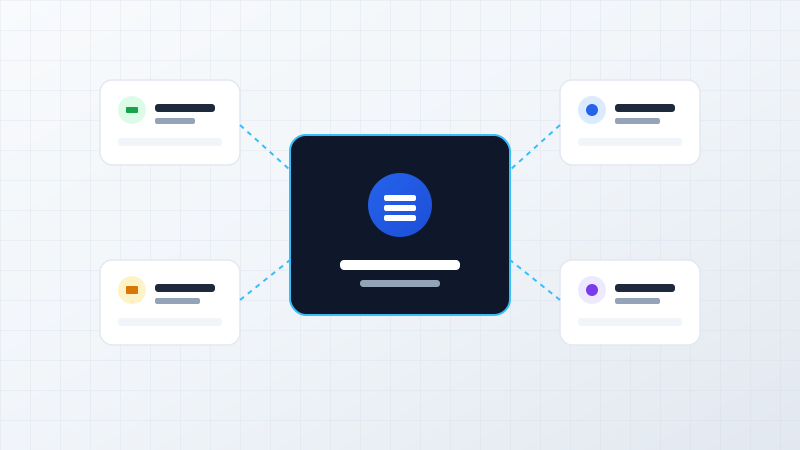
In mature enterprise engineering, the smartest software leaders do not choose between 100% Build or 100% Buy. Instead, they implement The Hybrid Architecture: purchasing best-in-class commercial SaaS for commodity functions while building a custom core platform for proprietary business logic.
Under this architectural paradigm, your proprietary software acts as the intelligent orchestration hub, connecting to specialized external APIs via standardized REST or webhook interfaces:
Proprietary operational platform orchestrating best-in-class commercial APIs
NetSuite / QuickBooks / Tally API for general ledger and tax filing.
Stripe / Razorpay API for PCI compliance and tokenized card processing.
Twilio / SendGrid / WhatsApp Business API for automated dispatch.
Consider the extraordinary leverage of this hybrid model:
- You avoid spending $80,000 building custom accounting ledger software or compliance audit trails.
- You avoid spending $40,000 building custom credit card encryption vaults.
- You focus 100% of your software investment on building the specific customer portal, pricing calculation, or operational workflow that gives your business an insurmountable edge over competitors.
Executive Takeaway
"You don't have to build everything to build something deeply valuable. Build the 20% of your system that generates 80% of your competitive differentiation, and buy the commodity infrastructure that powers the rest."
10. Build vs Buy: Comprehensive Comparison
To assist executive evaluation, the table below compares commercial off-the-shelf software with bespoke custom software across 12 essential strategic dimensions:
| Strategic Dimension | Buy (Commercial SaaS / COTS) | Build (Bespoke Custom Software) |
|---|---|---|
| Initial Capital Investment | Usually Lower (Subscription fees + implementation) | Higher (Upfront discovery, architecture & engineering) |
| Time to Initial Launch | Faster (Days to weeks for standard deployment) | Longer (3 to 6 months for complete custom MVP) |
| Workflow Customization | Limited (Bound to vendor configuration settings) | Unlimited (Engineered 100% to business rules) |
| Operational Business Fit | Standardized (Business must adapt to software) | Tailored Fit (Software adapts to actual workflows) |
| Software & IP Ownership | Vendor Owned (You rent access via subscription) | Company Owned (Valuable proprietary IP asset) |
| Ongoing Maintenance | Vendor Maintained (Included in subscription fee) | Internal / Partner (Supported by dev partner/team) |
| Feature Upgrade Roadmap | Vendor Controlled (Prioritized across thousands of users) | Business Controlled (Prioritized for your needs) |
| Integration Capabilities | Platform Dependent (Restricted to vendor APIs) | Full Freedom (Connects to any API, database, machine) |
| Competitive Differentiation | Low (Competitors can purchase the exact same tool) | High (Proprietary workflows create market moat) |
| Vendor Dependency Risk | Higher (Vulnerable to price increases & lock-in) | Lower (Full control over code and database) |
| Internal Product Ownership | Lower (Vendor product managers drive roadmap) | Higher (Requires internal business product owner) |
| Cost Scaling with Headcount | Linear Escalation (Costs multiply with user seats) | Infrastructure Bound (Zero per-user license fees) |
11. Decision Factor 1: Is This Capability a Competitive Differentiator?
The first and most critical evaluation filter is strategic value. Ask your leadership team:
“If our software executes this capability 50% faster, with 10x better precision, or with a dramatically better client experience, will customers choose us over competitors?”
If the Answer Is NO
The capability is an operational commodity. No customer selects a supply chain partner because they love their internal accounting software, expense reporting tool, or standard email client.
Recommendation: BUY a proven off-the-shelf product and adapt your process to its conventions.
If the Answer Is YES
The capability is a core business differentiator. Forcing it into generic software compromises your speed, customer satisfaction, and margin structure.
Recommendation: BUILD custom software or a dedicated hybrid extension around this specific workflow.
12. Decision Factor 2: How Unique Is the Workflow?
Software requirements exist along a continuous spectrum of operational uniqueness. Understanding where your specific workflow sits on this spectrum clarifies whether commercial software can succeed:
Commodity Functions (Strong BUY Case)
- Double-entry statutory accounting
- Employee payroll & direct deposit
- Corporate email & document storage
- Credit card gateway processing
- Standard outbound marketing email blasts
Proprietary Functions (Strong BUILD Case)
- Custom manufacturing job scheduling
- Multi-tier dynamic dealer discount matrices
- Specialized service booking & inspection audits
- Proprietary estimation algorithms
- Integrated IoT machine telemetry portals
The further to the right your workflow sits, the higher the likelihood that purchasing an off-the-shelf platform will result in frustration, costly customizations, and employee rejection.
13. Decision Factor 3: Time-to-Market & Opportunity Cost
Time is an economic variable with immense consequence. When evaluating Build vs Buy, executive leadership must weigh Implementation Lead Time against Opportunity Cost:
- If your business faces an immediate regulatory compliance deadline in 45 days, spending 6 months architecting custom compliance software is unviable. Purchasing an existing certified SaaS product is the only rational decision.
- Conversely, if your enterprise is losing $20,000 every month to manual order errors, spreadsheet reconciliation delays, and customer churn, taking 4 months to engineer a bespoke automated platform that eliminates those losses permanently pays for itself within its first year of operation.
Do not evaluate time in isolation. A SaaS tool implemented in two weeks that solves only 50% of your operational bottleneck creates ongoing daily friction that compounds into hundreds of lost operational hours every month.
14. Decision Factor 4: Total Cost of Ownership (TCO)
One of the most dangerous executive mistakes is comparing only Monthly Subscription Fees against Initial Custom Development Quotes. Both comparisons miss the true economic reality: Total Cost of Ownership (TCO) over a 3 to 5-year operating horizon.
The Real TCO of Buying (SaaS)
- •Annual subscription licensing (often escalating 7–15% yearly)
- •Per-user seat charges across every employee, field worker, or contractor
- •Third-party implementation & configuration consultant fees
- •Premium API access fees & webhook rate-limit add-ons
- •Employee time spent executing manual workarounds for unsupported edge cases
- •Substantial data extraction and migration costs if you outgrow the vendor
The Real TCO of Building (Custom)
- •Comprehensive discovery, UX design & system architecture
- •Frontend, backend, database & integration engineering
- •Automated QA testing, load testing & security hardening
- •Cloud hosting infrastructure (AWS, DigitalOcean, Azure)
- •Ongoing maintenance, security patches & library upgrades
- •Periodic feature roadmap enhancements as business needs evolve
Economic Law
"The cheapest option in Year 1 is rarely the cheapest option across a 5-year operating horizon — and the reverse is equally true."
15. The 5-Year Cost Horizon: Conceptual Economic Model
To conceptualize how cash flows behave across time between commercial software and custom development, examine this representative lifecycle curve:
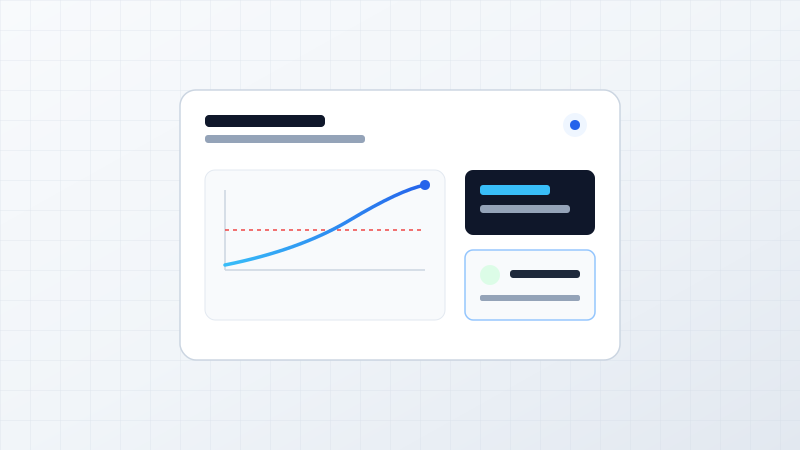
Comparing upfront capital intensity against compounding subscription licensing over time
In Year 1, buying software almost always incurs lower capital expenditure. However, as the organization scales its team, adds branches, or requires premium integration tiers, the cumulative cost curve of SaaS escalates steadily. For businesses with steady operational scale, custom software typically reaches an economic crossover point between Year 2 and Year 3, after which ongoing operating costs are significantly lower than SaaS seat fees.
16. Decision Factors 5 to 8: Users, Integrations, Data & Product Ownership
Beyond competitive differentiation and direct financial costs, four additional operational factors dictate the success of your software decision:
Factor 5: Number of Internal & External Users
Off-the-shelf SaaS pricing is almost universally anchored to per-user licensing ($30 to $150 per user per month). If your system must be accessed by hundreds of internal employees, field contractors, distributors, or external clients, SaaS licensing models impose a steep financial penalty on expansion. Custom software operates on fixed cloud server compute, allowing thousands of authenticated users without paying seat penalties.
Factor 6: Integration Topology & System Interoperability
Software does not exist in a vacuum. Does your system need to communicate in real time with:
- Your legacy ERP or accounting database?
- Factory floor machines, barcode scanners, or IoT weighing scales?
- Customer e-commerce portals and mobile apps?
- Third-party logistics, shipping, and courier dispatch APIs?
- Automated WhatsApp, SMS, and transactional notification gateways?
If an off-the-shelf tool lacks open APIs, charges exorbitant fees for webhook access, or restricts batch exports, integration friction will consume substantial engineering resources.
Factor 7: Data Sovereignty, Security & Compliance
Where must your data reside? Certain regulated industries (finance, healthcare, defense, enterprise supply chain) have strict data residency requirements, audit trails, and security governance rules. With custom software, you control the database engine, encryption keys, network firewalls, and hosting geography. However, custom software also means your team bears responsibility for maintaining secure configurations.
Factor 8: Internal Product Ownership Capability
This is the factor most frequently neglected by leadership. Who within your organization will own the software?
Custom software requires someone to define user requirements, prioritize enhancement requests, gather employee feedback, and review feature releases. If your organization lacks an executive sponsor or operational lead capable of steering the software, custom development can suffer from scope drift. If internal ownership is absent, buying a standardized platform with pre-configured workflows is generally safer.
17. The Executive Decision Tree
When leadership must resolve a software dilemma, follow this structured executive decision pathway:
Executive Build vs Buy Decision Pathway
A systematic framework based on solution coverage, operational flexibility, and strategic ROI
18. The Decision Scorecard
Use this executive scorecard to tally your organization’s operational characteristics across the three primary pathways:
Lean Toward BUY
- ✓ Requirement is an industry commodity (accounting, email, payroll).
- ✓ Speed to launch is your primary operational priority.
- ✓ An existing off-the-shelf platform covers 85%+ of workflows cleanly.
- ✓ Your team has limited capacity for internal product management.
- ✓ The feature provides zero direct competitive differentiation.
Lean Toward HYBRID
- ✓ Back-office bookkeeping is standard, but customer operations are unique.
- ✓ Commercial platforms offer robust APIs and webhooks.
- ✓ You want rapid market entry without sacrificing proprietary edge.
- ✓ You want to avoid reinventing complex payment/tax infrastructure.
- ✓ A bespoke portal can orchestrate multiple external services smoothly.
Lean Toward BUILD
- ✓ Your operational workflow is unique and defines your competitive advantage.
- ✓ Off-the-shelf software requires frustrating workarounds and spreadsheets.
- ✓ High user volume makes per-seat SaaS licensing economically prohibitive.
- ✓ You require full ownership of proprietary intellectual property.
- ✓ Your leadership is committed to ongoing product ownership and evolution.
19. A Realistic Enterprise Example: The Modern Distribution Company
To demonstrate how these principles apply in commercial practice, consider a mid-sized regional distribution company with $25M in annual turnover, 70 employees, 3 warehouses, and 400 retail dealer partners.
The company requires a comprehensive technology overhaul. Rather than attempting to buy a single rigid $200k ERP package or attempting to build everything from scratch, the leadership implements an optimized hybrid strategy:
This architecture is the hallmark of modern digital strategy. The business did not spend a single rupee building a custom accounting engine or payment gateway. Instead, it invested its capital into a proprietary dealer portal and pricing engine that increased monthly order volume by 35% while keeping administrative overhead completely flat.
20. Don’t Build Software Just Because You Can & The MVP Approach
In technology advisory, we frequently caution clients against the inverse trap: building custom software simply because they have the budget or technical ambition to do so.
Engineering teams frequently make five catastrophic mistakes when commissioning custom software:
- Reinventing Standard Wheels: Spending time building custom user authentication, password reset flows, or PDF invoice generators from scratch instead of leveraging proven open-source packages.
- Underestimating Post-Launch Lifecycle Maintenance: Allocating 100% of the budget to initial development and forgetting that server hosting, monitoring, OS upgrades, and feature enhancements require ongoing attention.
- Building Before Process Stabilization: Attempting to code a system before business owners have agreed on the manual operational steps. Automating an undisciplined process simply gives you automated chaos.
- Over-Engineering Architecture: Designing a massive distributed microservices cluster for a simple business application that would run faster and cheaper on a unified application container.
- Scope Bloat in Version 1.0: Attempting to pack five years of executive wishlist features into the initial release, delaying launch by a year and resulting in user rejection.
The Disciplined MVP Approach
If your organization determines that building custom software is justified, execute with an incremental, user-validated roadmap:
Isolate the Core Operational Bottleneck
Pinpoint the single most painful, error-prone workflow causing delays or customer frustration.
Build & Deploy the Lean MVP
Develop the simplest robust version that solves this specific bottleneck for a pilot group of real users.
Gather Production Feedback & Iterate
Observe actual employee interactions, refine edge cases, and eliminate workflow friction.
Expand Incrementally Around Proven Value
Add secondary modules, automated reporting, and external integrations only after the core workflow is stabilized.
Guiding Philosophy
"The objective of software engineering is not maximum customization. The objective is maximum business value delivered with the least necessary operational complexity."
21. Contextual Perspectives: Further Reading
Strategic technology decisions are closely connected to software architecture, operational maturity, and enterprise modernization. Explore our related business and engineering publications:
- Deep-Dive on Custom Justification: For a comprehensive analysis of when business complexity warrants bespoke engineering, read When Does a Business Actually Need Custom Software?
- ERP Evaluation Guide: If your organization is specifically evaluating enterprise resource planning platforms, review our practical guide Custom ERP vs Ready-Made ERP: Which Is Right for Your Business?
- Spreadsheet Migration Signals: Recognize when your operational workarounds are costing you real money in 5 Signs Your Business Has Outgrown Excel.
- Architectural Spectrum: Understand how modern systems scale efficiently in Monolith vs Microservices: What Should You Actually Choose?
- Engineering Capabilities: Learn how ByteStream designs scalable business systems across Custom Software Development and Systems Integration.
22. How ByteStream Approaches Build vs Buy Decisions
At ByteStream, we partner with founders, CEOs, and operational leaders as trusted technology advisors. When our engineering practice evaluates a new software initiative, we follow a rigorous 8-step decision process:
- Understand the Underlying Business Problem: We clarify the commercial objective before discussing technology.
- Map Current Operational Workflows: We trace how data, orders, and customer requests actually move through the business.
- Isolate Commodity vs. Differentiated Workflows: We separate standard utilities from proprietary capabilities.
- Audit Existing Commercial SaaS Platforms: We determine whether proven tools can solve the commodity requirements cleanly.
- Evaluate API Integration Topologies: We assess the feasibility of connecting commercial platforms into a unified data model.
- Model Total Cost of Ownership over 5 Years: We calculate real development, subscription, infrastructure, and maintenance projections.
- Define the Minimal Essential Custom Scope: We architect only the custom software necessary to capture business value.
- Design, Build, and Deploy Incrementally: We deliver reliable, secure production software in focused, user-validated iterations.
We begin by asking how little software we need to build to solve the business problem properly.
Build vs Buy: The Simple Answer
- BUY when the problem is an industry commodity and mature commercial products already exist.
- BUILD when the capability is unique, strategically important, and creates defensible competitive advantage.
- HYBRID when standard commercial platforms can handle back-office utilities while custom software powers your core customer and operational experience.
Final Principle
Buy what is standard. Build what makes your business different. Integrate everything that needs to work together.